![kimoby-logo_g-black (4).webp]](https://help.kimoby.com/hs-fs/hubfs/kimoby-logo_g-black%20(4).webp?height=40&name=kimoby-logo_g-black%20(4).webp)
The Estimates feature helps simplify, accelerate, and modernize repair and payment processes. It allows you to effortlessly create professional, clear estimates that increase both revenue and customer satisfaction.
With built-in Multi-Point Inspections (MPIs), along with the ability to attach photos and videos, you can give customers a transparent and personalized view of their vehicle’s condition. This helps them clearly understand recommended repairs and their urgency. Customers can then review and approve individual repairs instantly, directly from their mobile phones.
The Estimates feature is an essential tool for presenting additional repairs clearly and confidently, making approvals faster and easier for both your team and your customers.
Quick Links
Creating an Estimate
Creating an Estimate from an MPI
To create a new Estimate from an MPI, follow these steps:
- Click the Repair Orders tab.
- Open the Repair Order of the customer you want to create an estimate for.
- Click Create estimate at the top-right.
- Under MPI Findings, select the inspection element(s) you want to create an estimate for.
- Click on the
 # Jobs button to add them to the estimate.
 - Optional: Click Add Video to add a walk-around video.
- Optional: Click on the + Add Job button to manually add a new job. Click here to learn more about manually adding a job.
- When finished adding jobs, click Publish.
- At the top of the page, click Send to customer to send the customer the estimate via text message.
Creating an Estimate Manually
You can follow the interactive walkthrough below for a step-by-step guide to creating estimates manually (without an MPI) in Kimoby :
https://kimoby.storylane.io/share/ngf0aknsg045
Or you can follow these steps:
- Click the Repair Orders tab.
- Click the Estimates sub-tab.
- Click Create estimate at the top-right.
- Click the pencil icon under Customer.
- Search for the customer you want to create an estimate for and click Add.
- Click Save.
- Optional: Click Add Video to add a walk-around video.
- Click + Add Job to add a new job to the estimate. Click here to learn more about manually adding a job.
- When finished adding jobs, click Publish.
- At the top of the page, click Send to customer to send the customer the estimate via text message.
Adding a Job to an Estimate
Kimoby estimates are built from Jobs, which groups related work, parts, and labor into organized sections.
To add a new job to an estimate:
- Click the Repair Orders tab.
- Click the Estimates sub-tab.
- Create a new estimate or open an existing one.
- Click + Add Job.
The Add Job window will appear. - The left side of the window is all about the problem. Describe the concern (why the customer came in) and the cause (the problem your team found). You can also attach photos or videos to support the job.
- Optional: Add the concern and the cause in the appropriate boxes on the left.
- If an MPI was done for this estimate, you can search for the appropriate inspection element(s) under MPI Findings and add them to the estimate by clicking on them.
- Optional: Under Medias, add any photos or videos relative to this job.
- Check the Hide from customer box if you don’t want this job to appear on the estimate.
- Under Corrections:
- Enter the Op Code of the work that needs to be added to the job. Click here to learn more about adding op codes to your database.
- Optional: In the Op Code Name field, add a name for the correction.
- The selected op code will automatically populate the Correction box.
- Select the pay type for this correction: whether Customer pay, Internal, or Warranty.
- Under Labor:
- Click the clock icon
 to select an hourly rate or the dollar icon
 to select a flat rate.
 - Enter the rate and, if it’s an hourly rate, the number of hours.
- Click the clock icon
- Under Parts:
- Click + Add Part to add a new part.
- Enter the part number. Click here to learn more about adding parts to your database.
- Enter the name of the part.
- Enter the quantity and price per unit.
- Select the availability of the part: whether Available, Unavailable, or Pending.
- Under Fees:
- Click + Add Fee to add a new fee.
- Enter the name of the fee.
- Enter the quantity and price per unit.
- Click Add Correction if another correction needs to be added to this job.
- Click Add Job when finished.
Navigating the Estimates Page
The Estimates page, found under the Repair Orders tab, is where you can view all of your estimates, past and present, and their approval status.
Filtering Estimates
There are a few ways that you can choose what estimates to view on this page:
- Direct search: You can use the search bar within the page to search for a specific estimate by reference number, customer name, or repair order number.
- Date range: You can choose to view only estimates from a specific date or range of dates. Click the calendar icon to select the dates.
- Filter: You can filter your estimates list by clicking on the Filter icon
 and selecting filters such as status, sent or not sent, etc.
 - Author: You can filter estimates by which user created the estimate (called an author). Click on the Author icon
 and select one or more users to view only the estimates they created.
Estimate Statuses
An estimate can have five possible statuses: Draft, Needs Approval, Approved, Partially approved, and Denied.
- Draft means the estimate has been started but has not been finalized or sent to the customer.
- Needs approval means the estimate has been sent to the customer, but not yet approved or declined.
- Approved means the entire estimate has been accepted by the customer.
- Partially approved means only part of the estimate has been accepted.
- Denied means the entire estimate has been declined by the customer.
Note
If any line on an estimate remains “Pending,” the estimate will retain the Needs approval status, even if all other lines have been approved or denied.
Exporting Estimates
You can export your list of estimates for analysis by following these steps:
- Click on the Repair Orders tab.
- Click on the Estimates sub-tab.
- Click Export at the top-right.
- Choose your parameters for exporting: All, Filtered results, or Date range.
- Select All if you want to export all results.
- Select Filtered results if you want to export only the results you filtered on the previous page.
- Select Date range if you want to export only the results for specific dates.
- Click Export estimates.
Viewing Estimate Details
When you open an estimate, you’ll see all the details that matter in one place, including jobs, price breakdown, and associated inspections.
To open an estimate and see its details, follow these steps:
- Click the Repair Orders tab.
- Click the Estimates sub-tab.
- Click on the estimate you want to open.
At the top of the page, you will see details such as the estimate name and status as well as options to send the estimate to the customer or edit/publish it.


Just below the header you can find the customer details:
- Customer name
- The Repair Order connected to the estimate
- Customer vehicle
- Customer VIN

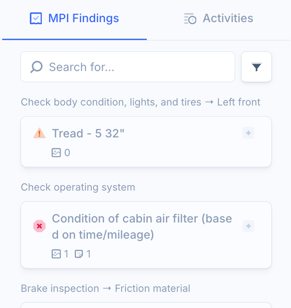
Under MPI Findings, you will see the elements from the multi-point inspection report that were marked as either  Requires immediate attention or
  May need future attention. These elements can be used to create jobs for your estimate.
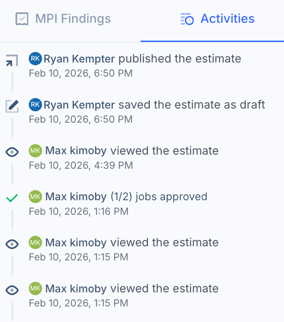
Under Activities, Kimoby keeps a log of all the actions taken within the estimate, including viewing the estimate, so you can track exactly what actions were taken by which user at what time.
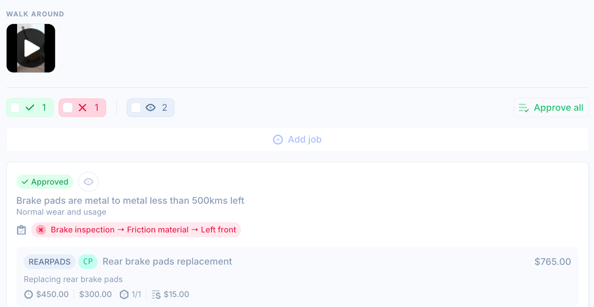
On the right side of the estimate, you can see all the jobs that are part of the estimate and any walk-around videos associated with the estimate. You can also add new jobs to the estimate here.
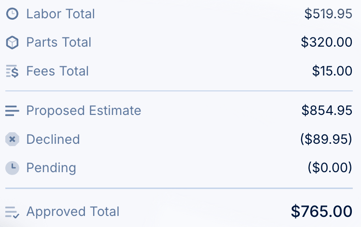
Finally, near the bottom of the estimate, you will find the total cost, as well as the Detailed breakdown of the cost.
The Detailed breakdown shows the full price of each part of the estimate, such as labor, parts, and fees. The breakdown will also show how much was approved or declined.